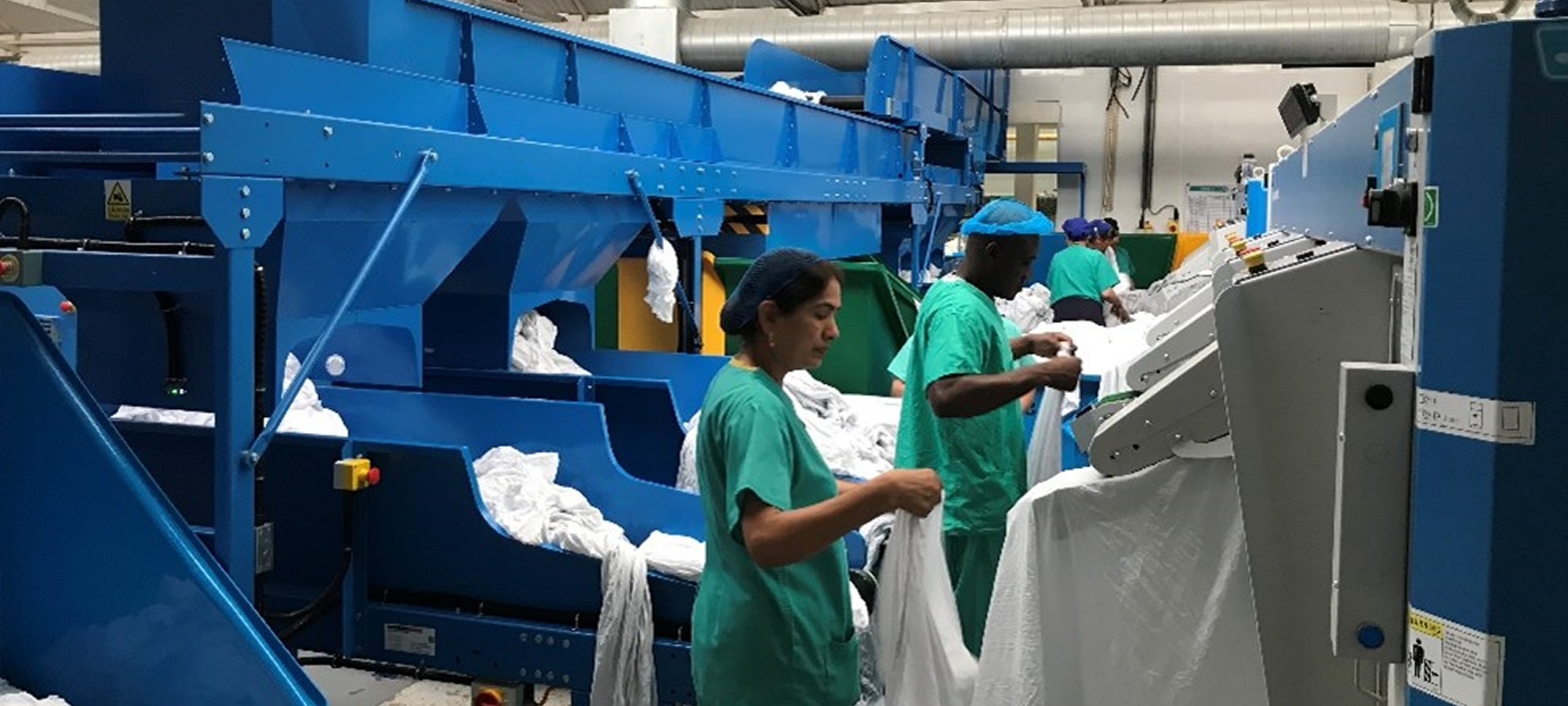
Wäscheförderbänder
Gewerbliche Wäschereien verarbeiten typischerweise über 500.000 Wäschestücke pro Woche. Um dies effizient zu gestalten, ist Automatisierung unerlässlich. Förderbänder bilden das Rückgrat automatisierter Transportsysteme in Wäschereien und befördern die einzelnen Wäschestücke von der Annahme der Schmutzwäsche über die Reinigungsprozesse bis hin zur Verpackung und dem Versand an den Kunden.
Typische Förderbandanwendungen in Wäschereien sind:
- Schmutzwäsche sortieren
- Indexierstufenförderer zum Beladen von CBW-Waschmaschinen mit 50–100 kg Lasten
- Kuchenförderbänder
- Wäschesortierbänder und -plattformen
- Trocknerbeladung von Shuttlewagen und Förderbändern für die Mitnahme
- Ein- und Auslaufbänder für Schrumpfverpackungsmaschinen
Viele Wäschereien arbeiten auf etablierten Standorten mit bereits vorhandener, älterer Ausrüstung. Eine Herausforderung bei der Automatisierung besteht darin, ausreichend Platz für die Installation von Förderbändern zu finden. Alle Amber-Förderbänder werden individuell für den jeweiligen Einsatzbereich konzipiert und gefertigt und können daher durch Anpassung von Länge, Breite und Höhe des Bandes optimal an die jeweiligen Standortanforderungen angepasst werden.
- Betten aus pulverbeschichtetem Baustahl mit Blenden aus Edelstahl oder pulverbeschichtetem Stahl
- Glatte Innenflächen
- lückenlose Innenflächen
- Gesäumte Kanten an Gardinenblenden
- Durchlaufbänder
- Robuste Fingerschutzvorrichtungen befinden sich auf der Oberseite der Walze.
- Horizontale Förderbänder werden unmittelbar vor den Fallübergabepositionen bevorzugt.
- Erhöhte Förderbandgeschwindigkeit beim Transfer von einem Band zum anderen
- Keine Belastung oberhalb der Seitenwände der Gardinenblenden
- Die Fallhöhen zwischen den Förderbändern dürfen nicht geringer sein als die Höhe der Zuführförderbandkante.
Frequently Asked Questions About Laundry Conveyors
Laundry conveyors automate the movement of linen through commercial laundry operations. They can transport linen from dirty linen receiving and sorting areas, through washing, drying, ironing and folding processes, and finally to packing and dispatch.
Typical applications include dirty linen sorting, indexing step conveyors for loading Continuous Batch Washers (CBW), cake conveyors, linen sorting belts and platforms, dryer loading shuttle cars and takeaway conveyors, and shrink wrapper infeed and outfeed belts.
Yes. Many commercial laundries operate on established sites where space is restricted by existing equipment. Amber designs and builds its laundry conveyors for the individual application, allowing dimensions such as belt length, width and height to be tailored to the site.
Belt conveyors can move dirty linen from delivery vehicles to sorting or washing areas. After washing, pressed linen or “cakes” can be conveyed to sorting areas or directly to dryers, while further conveyors can transfer dried linen towards ironing and folding operations.
Amber identifies snagging as a major consideration when conveying loose linen. Internal conveyor surfaces should therefore be smooth, continuous and wherever possible gap-free, with particular attention paid to avoiding narrowing gaps where linen could become trapped or wedged.
Where one conveyor transfers linen onto another, Amber recommends that the takeaway conveyor operates faster than the feed conveyor. This speed differential helps reduce the possibility of linen becoming trapped at the transfer point and is particularly important when transferring from a declined conveyor to a horizontal conveyor.
Small-diameter rollers, such as the 60 mm diameter rollers referenced by Amber, can be used at the head and tail of conveyors to reduce the V-shaped gap between adjoining rollers. This reduces the distance linen must travel when transferring between conveyors and helps reduce trapping.
Tuck-under occurs when linen sticks to the conveyor belt and begins following the return belt underneath the conveyor. Amber advises reducing belt friction where possible so that linen releases more easily. Where this is not possible, a sensor beneath the head roller can be linked to the conveyor emergency-stop system to detect the problem and stop the conveyor.
Depending on the conveyor arrangement and height, protection can include nip guards, full-panel underguards and local roller covers. Amber notes that guarding should provide appropriate protection while taking account of linen snagging, cleaning access, maintenance and the likelihood of operators coming into contact with moving parts.
Yes. Amber provides conveyor systems for moving linen through multiple stages of commercial laundry operations, and complementary materials-handling equipment such as lifts, hoists and shuttle cars can also be incorporated to improve the efficiency of linen movement around the laundry.